Visit Karlskrona
For more information about opening hours, events, guided tours and more.


You can translate karlskrona.se automatically using Google Translate.
Google Translate is a third-party service from Google. When you use the service, a script is downloaded to your browser. Read more about Googles Privacy Policy at https://policies.google.com/privacyThe World Heritage Naval Port of Karlskrona consists of fortifications, the naval dockyard and harbour, the military base and the civilian city, as well as facilities in the surrounding area that have been important sources of supply and support for the base.

What makes Karlskrona a World Heritage site is not a single building, but the whole. Here, the civil town, historical fortifications, naval dockyard, naval harbor, and surrounding facilities that once supported the naval base come together in a unique symbiosis. When you visit the World Heritage site Naval Port of Karlskrona, you also explore another of UNESCO’s unique designations – the Blekinge Archipelago Biosphere Reserve, where culture and nature meet in perfect harmony.
The places and buildings within the World Heritage site are owned and managed by different stakeholders, offering a variety of experiences. For opening hours, events, and more information, we refer to Visit Karlskrona or the respective stakeholder's website.
As a visitor, you are an important part of the World Heritage site’s future. By traveling thoughtfully and making sustainable choices, you help preserve this incredible place for future generations. For tips on how to contribute and experience the World Heritage site and biosphere reserve in a respectful and sustainable way, read our Code of Conduct.
Together, we can protect both our history and our nature, ensuring that Karlskrona’s Naval Port remains a place where cultural heritage continues to thrive in harmony with its unique environment.
Read and download the brochure in English
Eric Dahlberg collaborated with Nicodemus Tessin the Elder and Carl Magnus Stuart in the planning of the new city and its fortifications. The first city plan was completed by C M Stuart and approved in 1683 but replaced by a new one in 1694. The planned city was intended to be a manifestation of Sweden’s great ambitions and power. The various functions, such as civilian areas, dockyards, trade and industries, were gathered in a city plan designed with inspiration from the Roman Baroque period, such as a monumental square and city blocks drawn in a square pattern with streets radiating outwards. The northern part of Trossö consisted of the civilian city while the southern part of the island was occupied by the naval dockyard and naval harbour. This division into a civilian and a military part of the city still exists today.
Characteristic for Karlskrona were the very wide streets and the monumental square with its public buildings. In this classic grid plan the civilian part has its centre in the highest location, Stortorget, the square that is surrounded by stately buildings for religion and the administration of justice.
Karlskrona is one of the few places in the world where you can still experience environments created for the sailing naval ships of olden days. The first dockyard was located on Vämö, closer to the mainland, where three ships were built. After a few years this was moved to the southern part of Trossö, in 1684. Fortifications and buildings were built there, with complementary facilities on Lindholmen, Söderstjärna and Stumholmen. Already in the early 18th century, Karlskrona became a centre for technological innovation, where the foremost example is The Polhem Dry Dock. In addition to the more eye-catching buildings, such as The Rope-Walk (Repslagarbanan), The Vasa Shed (Wasaskjulet) and The Polhem Dry Dock on Lindholmen as well as the Five Finger docks and Old Mast Crane in the western dockyard area, older details are preserved in the dockyard environment, such as quays, dolphin mooring structures and grinders. The dockyard is still being utilised today, with shipbuilding operations in the western dockyard area and the Marine Base’s operation in the eastern area.
Experience the world heritage virtually
Immerse yourself in virtual reality and explore the historic naval shipyard Lindholmen, Polhemsdockan, Wasaskjulet, or Repslagarbanan. Embark on guided tours in a breathtaking World Heritage environment.
In 1993, after 300 years as a closed military area in the middle of Karlskrona, Stumholmen was transformed into a part of the civilian city. Today historic buildings are mixed with restaurants, private homes, tourist attractions and a university at the digital forefront – like a miniature version of Karlskrona where locals, tourists and students can meet and mix.
When Karlskrona, originally built on 33 islands, was granted its city rights, several of the islands as well as certain areas were reserved for the crown’s operations. In the fortification plan from 1683 Stumholmen was given the role of the fleet’s production and provisioning area, with workshops and storage rooms. There was a bakery, a charcuterie shop and a factory that made clothes for the military. The island was like a large supply facility that would ensure that the individual sailor and soldier received the food and equipment required both at war and in times of peace.
The fact that the area today is experienced as a single island is the result of landfilling between three islands: Stumholmen, Laboratorieholmen and Bastion Kungshall. The buildings that today are on land can have been located along a waterline during the time of their construction.
On Stumholmen you will find military buildings from the 18th century up until the 1950s. Most of the original buildings are still standing and are being used for various purposes, some more modern than others.
Skeppsholmen in Stockholm was built for the same function as Stumholmen, however, they differ architecturally. Stumholmen was designed by engineers and fortification officers with a focus on expediency and function. The buildings were therefore given a strict exterior design with few ornamentations but with some contrast formed by the choice of façade materials, such as grey limestone against red-tarred panels. The buildings that were erected during the early 19th century were designed with classicistic features with influences from the architectural ideals of that time.
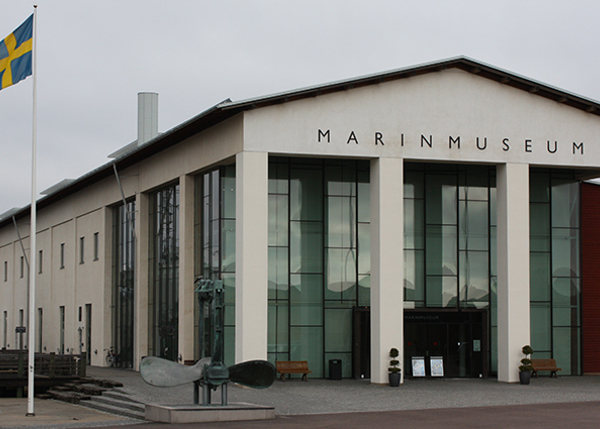
Since Karlskrona was founded, Stumholmen was a closed military area in the middle of the city. In connection with the Housing Fair of 1993, the island was opened to civilians and a new district was created in harmony with the culturally and historically unique environment. Today, Stumholmen houses everything from parks and beaches to homes and workplaces. The Marine Museum has been the World Heritage City of Karlskrona’s tourism magnet on Stumholmen since it opened in 1997. Even more so since the submarine hall with the attraction HMS Neptune was inaugurated in 2014.
When Karlskrona was built, the location was chosen strategically. The natural protection and barrier that surrounded the archipelago Trossö and surrounding adjacent islands provided good conditions. There was both a narrow and deep fairway which could easily be defended against attack, as well as room for a large, protected, harbour basin.
A series of fortifications were built from the time of the creation of the naval base onwards, partly on Trossö and the adjacent islands, partly in the sea at the outer, western, and eastern areas where the ships anchored. In accordance with Erik Dahlbergh’s intentions, in 1680 work began to fortify the entrance to Karlskrona through the construction of the Drottningskär Citadel and the fortress of Kungsholm. The citadel was originally the main fortification, a role that Kungsholm then took over from the beginning of the 19th century. Further in, towards the island of Trossö, are the fortifications of Koholmen, Mjölnareholmen and Ljungskär from the 18th century. Originally, ports and dockyards in Karlskrona were meant to be protected against attack from both water and land by a circle of fortresses.
The founding and construction of Karlskrona had a major impact on the city’s surroundings as it meant that a profitable market was opened. Large quantities of food, timber, tar, and iron were delivered to Karlskrona and the Admiralty. Trade was particularly extensive during the construction of the naval dockyard and during wartime, when the military presence increased in the city. The newly built city lacked hydroelectric power, which instead could be found in Lyckeby. It was also from Lyckeby that fresh water, needed for the civilian city and the Navy, was brought.
Around Karlskrona there is a number of smaller mansions that were constructed in pace with the city. From the end of the 17th century, citizens, officials, and officers bought individual farmhouses in the villages around Karlskrona. By buying several farms they created larger country estates. These functioned both as agriculture farms that supplied the Navy and as summer residencies. The country house Skärva, which was built for Fredrik Henrik af Chapman in the 1780s, is an example of one of these country estates.